




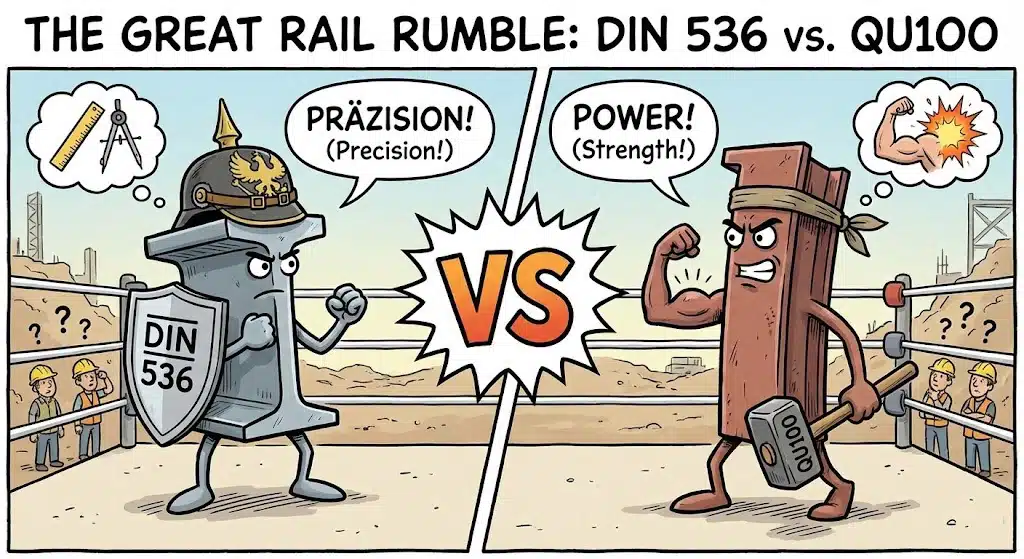
1.Introduction to Two Popular Crane Rail Standards
When designing a heavy-duty gantry crane system, engineers, project managers and procurement teams often face a critical dilemma when selecting a reliable rail. The two most widely adopted options across global industrial markets are the European DIN 536 standard A-series and the Chinese GB standard QU-series crane rail.
Both types of crane rail are engineered to withstand extreme heavy loads and long-term industrial operation, but they feature distinct structural parameters, material properties and installation requirements. They are not perfectly interchangeable in most existing projects.
At Forgesail, we receive a large number of technical inquiries every year about replacing A100 with QU100 to control overall project costs. To help you make a wise decision, we have compiled a full professional breakdown of the differences between these two mainstream rail models below.
Introduction When designing a heavy-duty gantry crane system, engineers often face a dilemma: Should you stick to the European DIN 536 standard (A-series) or choose the Chinese GB standard (QU-series)? While both are excellent for heavy loads, they are not perfectly interchangeable.
At Forgesail, we frequently receive inquiries about substituting A100 with QU100 to save costs. Here is a professional breakdown of the differences.
2.Profile & Dimensions of Each Crane Rail
2.1 DIN 536 A100 Crane Rail
The most obvious difference between the two crane rail products lies in their rail head shape and base width.
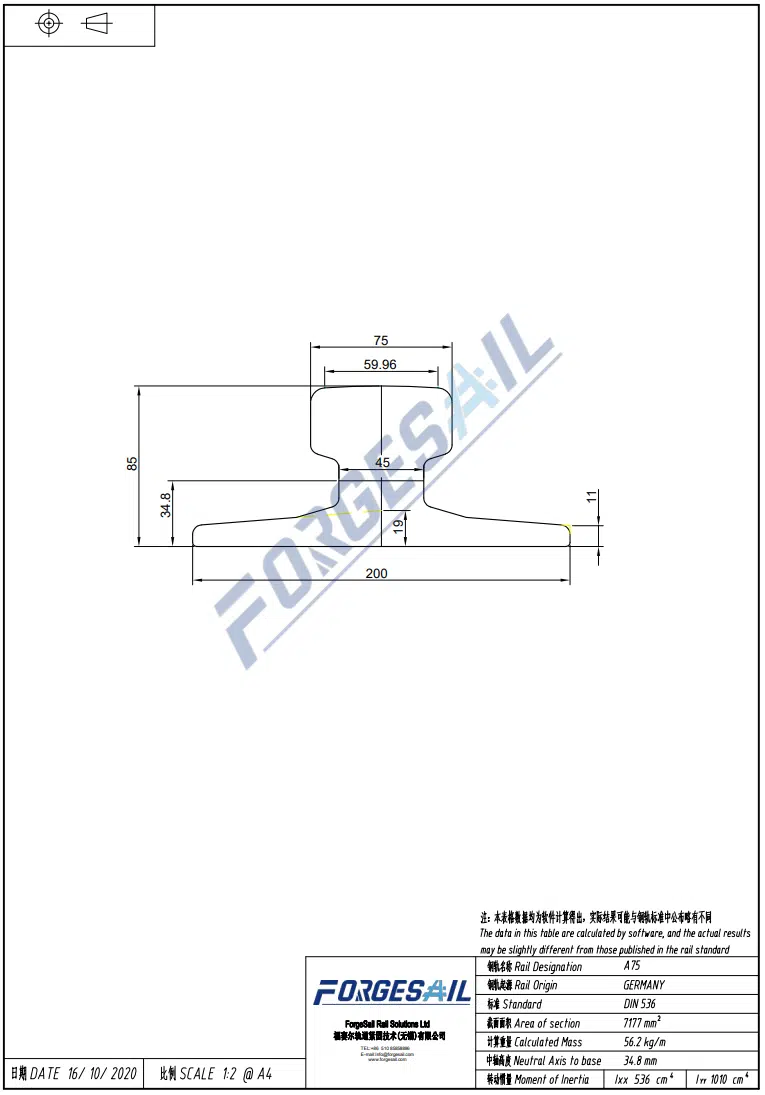
DIN 536 A100 is designed with a wide, low profile, and its rail head reaches a standard width of 100mm. Thanks to its low center of gravity, this rail delivers outstanding stability when bearing lateral loads, which makes it a top pick for traditional European gantry crane and port equipment.
2.2 QU100 Crane Rail
In contrast, QU100 has a taller overall profile, and its rail head is slightly narrower than the base section. Its appearance is similar to conventional railway rail, yet the whole body is thicker and more robust for heavy industrial use. This structural design gives the QU100 excellent vertical load-bearing capacity.

3. Chemical Composition & Hardness of Crane Rail Materials
Material quality directly decides the service life and safety performance of a crane rail. Different manufacturing standards adopt completely different steel grades.
DIN standard rail is generally produced with 900A grade steel, with a minimum tensile strength of 880 N/mm². This material meets strict European industrial standards and guarantees stable performance in long-cycle operation.
QU series crane rail is made from high-quality U71Mn steel. This steel contains higher manganese content, so the finished rail boasts superior wear resistance and surface hardness. Its tensile strength usually exceeds 980 N/mm², performing well in high-frequency friction and harsh working environments.
4. Installation & Matching Accessories for Crane Rail
Installation compatibility is the key factor you cannot ignore when switching one crane rail for another, which mainly depends on the base width of the crane rail.
- A100 base width: 200mm
- QU100 base width: 150mm
If your on-site concrete foundation or pre-installed sole plates are customized for A100 crane rail, you cannot simply replace it with QU100. You will have to replace the entire supporting and fixing system, including rail clipsand rubber rail pads, which will bring extra construction work and cost.
5. Final Selection Advice for Your Crane Rail
Choosing the right rail depends largely on your project location, construction type and existing equipment standards.
If you are launching a brand-new construction project in Asia or Africa, QU100 is a cost-effective choice. Supported by large-scale domestic production, it balances quality and price perfectly.
For equipment maintenance, part replacement or renovation projects in Europe, or projects that strictly follow DIN tolerance rules, DIN 536 A100 crane rail is the only safe and compliant option.
You can check more official industrial specifications of industrial rail systems on international standard rail documentation for further reference.
Need help selecting the right rails for your project? Forgesail supplies both DIN and QU series with original Mill Test Certificates. Contact our engineering team for a free professional consultation.
FAQs
Q1: Can QU100 replace DIN 536 A100?
Answer: Yes, in most heavy-duty applications, QU100 is an excellent functional replacement for A100. Both are designed for high-capacity overhead and gantry cranes. However, because their geometric dimensions differ (A100 has a wider base, while QU100 has a thicker web), you cannot simply swap the rails without adjusting the fastening system. Our engineering team can help you verify the structural compatibility based on your specific wheel loads.
Q2: What is the equivalent Chinese standard for A100?
Answer: There is no exact 1:1 dimensional equivalent in the Chinese standard for DIN 536 A100. However, QU100 (manufactured under the YB/T 5055 standard) is the most widely accepted and specified alternative. It offers comparable tensile strength, load-bearing capacity, and durability for extreme industrial environments.
Q3: Which rail is better for port cranes (STS/RTG)?
Answer: Both are top-tier choices. A100 is traditionally specified in European-designed port equipment. Conversely, QU100 is highly favored in port expansions across Asia, the Middle East, and South America due to its robust head profile and outstanding cost-efficiency. The “better” choice depends entirely on your project’s engineering specifications and procurement budget.
Q4: Is QU100 cheaper than A100?
Answer: Generally, yes. By sourcing QU100 directly from a specialized manufacturer like FORGESAIL, contractors and EPCs can significantly reduce their overall track system costs. The mature steel supply chain in China allows us to offer highly competitive pricing and shorter lead times without compromising strictly required mechanical properties.
Q5: Can I use existing A100 clips with QU100?
Answer: No, they are not directly interchangeable. The base width of the A100 rail is 200mm, whereas the QU100 rail base is 150mm. This 50mm difference means your existing clip installation distance will be incorrect. When switching to QU100, you must use adjustable rail clips (such as weldable forged clips) and continuous rubber pads matched to a 150mm base. We can supply the complete matched fastening kit alongside the rails.
For a detailed guide on crane rail types and specifications →Read the full guide


