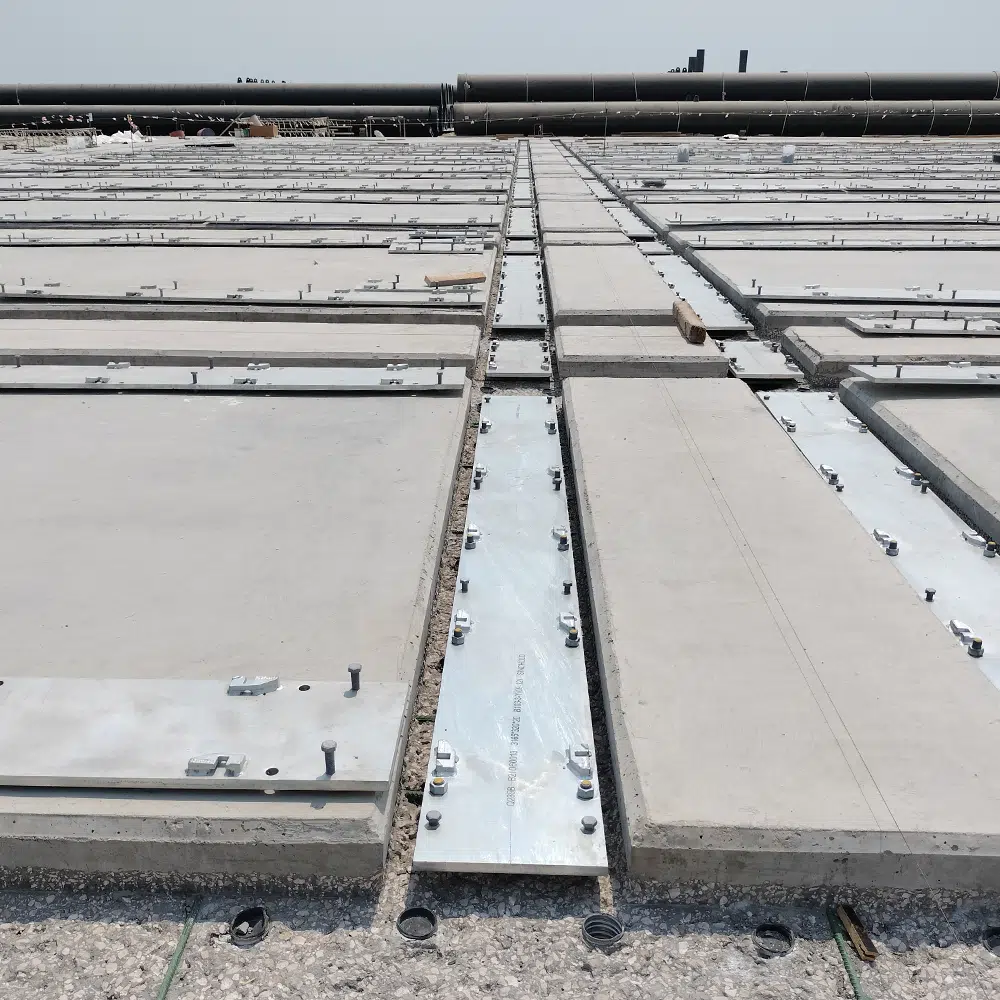
Forgesail’s Sole Plates provide critical support and load distribution for rail systems, ensuring stability and long-term track performance. Explore products like Sole Plates – Continuous and Sole Plates – Discontinuous, along with other solutions designed for railways, crane tracks, and heavy industrial applications. Click each product to learn more about its features and installation options.

Cost-Effective, Intermittent Support for Industrial Rail Systems
FORGESAIL Discontinuous Sole Plates (also known as individual base plates) provide targeted support exactly where it is needed—directly beneath the rail fastening clips. This intermittent support system is a highly economical and efficient solution for light to medium-duty crane tracks or ground-level railways where a full continuous plate is not structurally required.
By leaving strategic gaps between the plates, this design naturally prevents water and debris accumulation along the track, making it exceptionally easy to maintain in outdoor environments.

Continuous Sole Plates for Heavy-Duty Crane Runways
Forgesail manufactures continuous steel sole plates up to 2980 mm per plate, in 20 / 25 / 30 mm thickness (laser cut up to 35 mm), from Q235 plate with MTC, drilled and tapped to your pattern within ±1 mm and hot-dip galvanized to an average 70 µm coating. Plates run continuously with a 20 mm expansion joint — no splicing required.
Continuous sole plates give the crane rail uninterrupted full-length support instead of a row of short pads. That spreads wheel loads along the runway, keeps the rail from rocking at the plate ends, and makes the gauge stable over years of heavy use — which is why they are standard on container terminals, shipyards and steel mills. Because Forgesail cuts, machines, welds and galvanizes in its own workshop, the plates are made to your drawing rather than selected from stock sizes.
Send your sole plate drawing for a quote
Plate and processing specifications
| Material | Q235 carbon structural steel; Mill Test Certificate (MTC) supplied with the shipment |
|---|---|
| Common thickness | 20 mm, 25 mm, 30 mm — the final thickness follows the runway load design |
| Maximum cut thickness | 35 mm on our large-format laser cutter |
| Maximum sheet size | 6000 × 2500 mm |
| Continuous plate length | Up to 2980 mm per plate (recommended), with a 20 mm expansion joint between plates; plates are laid continuously, so no splicing is needed |
| Holes and threads | Drilled and tapped to your pattern in M12, M16, M20, M22 or M24; hole position tolerance ±1 mm |
| Welded assemblies | Hold-down (clamp) plates can be welded onto the sole plate as a complete assembly |
| Surface treatment | Hot-dip galvanized after all welding and machining, average coating thickness 70 µm — welds and cut edges are covered as well |
| Packing | Plates are packed with reinforcement that keeps them flat in transit and prevents deformation before installation |
| Custom work | Outline, plate thickness, hole pattern, edge preparation and welded details are all made to drawing |
Where continuous sole plates are used
- Container terminal quay (STS) and yard (RMG / RTG) crane runways
- Shipyard and heavy fabrication crane tracks
- Steel mills and continuous casting bays with high wheel loads
- Bulk handling, mining and cement plants where the rail sits outdoors or in dust
- Runway upgrades where the original scattered base plates are replaced by a continuous bed
- Repair projects on existing tracks, including single-section maintenance quantities
Installation notes
- Continuous run, no splicing: plates are laid end to end along the runway, with a 20 mm expansion joint between plates to allow thermal movement.
- Foundation first: check the concrete or grout bed for flatness and elevation before setting plates — a continuous plate follows the bed, so any hump shows up directly under the rail.
- Fixing: plates are fixed through the pre-drilled holes; where the design calls for it, the hold-down (clamp) plates are already welded to the sole plate and the whole assembly is galvanized as one piece.
- After installation: the rail is fastened with rail clips, rail pads and bolts matched to the same drawing, then gauge and straightness are set before final torque.
- Corrosion: because galvanizing happens after welding, there is no bare weld seam to rust — the usual starting point of corrosion on coastal runways.
Frequently asked questions about sole plates
Can sole plates be customised?
Yes. Sole plates are made to your drawing rather than picked from a fixed catalogue: length, width, thickness, hole pattern, edge preparation, welded details and surface treatment all follow the rail profile and base plate design of your runway. Send the drawing — or a sketch with the main dimensions plus a photo of the installed track — and we quote from that.
What thickness are sole plates normally made in?
The common thicknesses are 20 mm, 25 mm and 30 mm, and the final choice follows the load calculation in your design. Our large-format laser cutter handles plate up to 35 mm, so a specified thickness and outline can be produced to match the drawing instead of being limited to stock sizes.
Can hold-down plates be welded directly onto the sole plate?
Yes. Hold-down (clamp) plates can be welded onto the sole plate as a complete assembly, and the assembly is then hot-dip galvanized as one piece. Because galvanizing follows the welding, the coating covers the weld seams and the cut edges too, which is what keeps corrosion protection consistent on coastal, port and outdoor installations.
How long can a continuous sole plate be?
We recommend a maximum of 2980 mm per plate, and plates are laid continuously along the runway with a 20 mm expansion joint between them — so the track needs no splicing. At that length the plates are also given special packing reinforcement so they stay flat in transit: a plate that arrives twisted is the usual reason a continuous bed does not sit properly, and the packing matters as much as the machining.
Can holes be pre-drilled and threads tapped before delivery?
Yes, both. Holes are drilled and threads tapped in the workshop to your pattern in M12, M16, M20, M22 or M24, with hole position tolerance held to ±1 mm, so the plates arrive ready to bolt down and the site works to the hole positions of the original design. Welded assemblies can be drilled, tapped and galvanized as one piece as well.
What is the galvanized coating thickness?
The plates are normally hot-dip galvanized with an average coating thickness of 70 µm — measured across the surface, including the areas around welds and cut edges. Tell us if your specification calls for a different coating standard or a painted top coat, and we will quote to that instead.
What information do you need to quote a custom sole plate?
Six things are enough: the drawing or a dimensioned sketch, the rail profile (for example DIN 536 A100, QU100 or ASCE 85), the plate thickness, the hole pattern or hole positions, the quantity, and which processes you need — drilling, tapping, welded hold-down plates and galvanizing. If no drawing exists, send photos of the installed track with three measurements (rail base width, plate length and hole pitch) and our engineers will confirm the rest. Lead time is confirmed when the order is placed, according to the production schedule at that time.
Related crane rail components
Reference Projects