




Crane rail types are not interchangeable. Choosing the wrong profile affects wheel life, clip performance, and long-term runway stability.
Three families dominate industrial crane runways: A-section rails under DIN 536, QU rails under the Chinese standard YB/T 5055, and UIC rails under UIC 860 and EN 13674-1.
This guide explains the 7 critical differences between these crane rail types so engineers can specify the right rail with confidence.

1. Crane Rail Types by Standard: DIN 536, YB/T 5055 and UIC 860
A-section rails follow DIN 536, the German standard for crane rails. Common sizes run from A45 to A150.
QU rails follow YB/T 5055, the Chinese crane rail standard. Common sizes are QU70, QU80, QU100 and QU120.
UIC rails are defined under EN 13674-1 (formerly UIC 860). These are railway rails, with UIC 50, UIC 54 and UIC 60 as the most common sizes.
The key point: A-section and QU are purpose-built crane rails, while UIC rails were designed for railway track and adapted to cranes.
2. Naming of Crane Rail Types: Head Width, Height and Mass
The numbering systems differ, and this causes frequent specification errors.
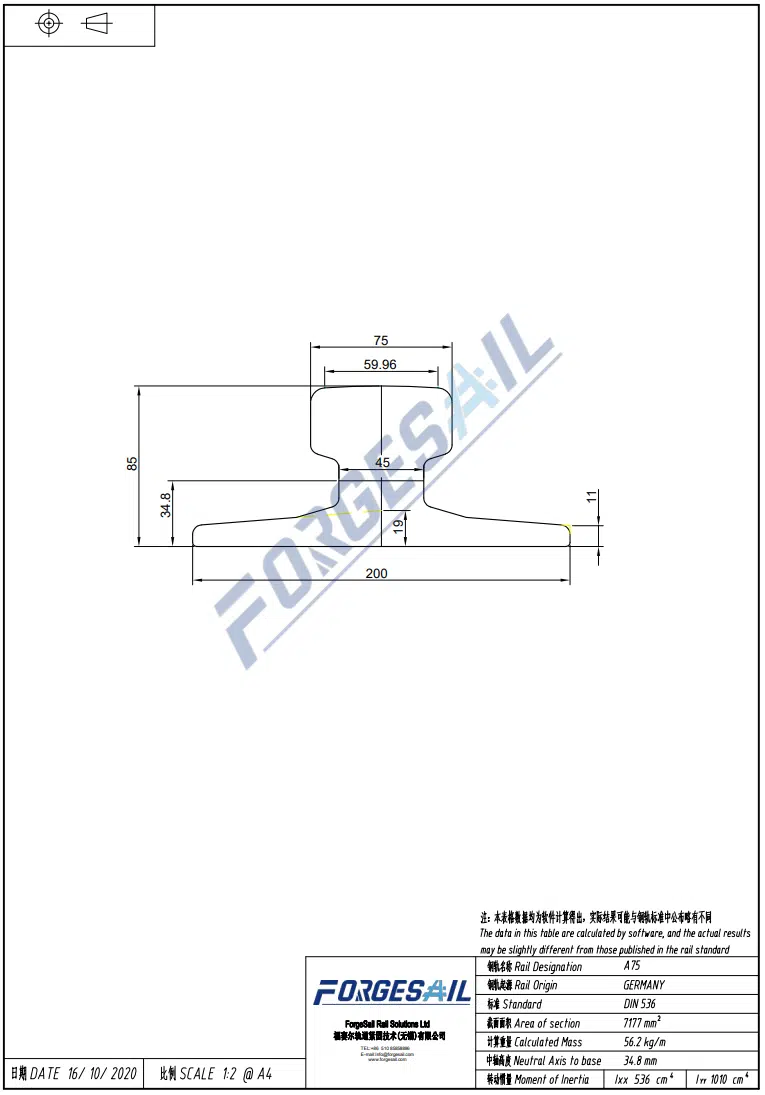
In DIN 536, the number denotes the nominal rail head width in millimetres — not the mass. An A75 rail has a 75 mm wide head, but its nominal mass is only about 56.2 kg/m. A100 has a 100 mm head and about 74.3 kg/m; A120 has a 120 mm head and about 100 kg/m.
In YB/T 5055, the number is the rail height in millimetres. A QU80 rail is 80 mm tall, with a nominal mass of about 63.7 kg/m.
In EN 13674-1, UIC rails also carry a profile code (50E1, 54E1, 60E1). UIC 60 / 60E1 weighs about 60.21 kg/m.
Never compare rails by number alone. A65 and QU100 are not the same class of rail.
3. Profile Geometry: Why Crane Rail Types Differ
Crane rail types differ most in head width, web thickness and overall height.
A-section and QU rails have a wide head and a thick web. This geometry resists high wheel pressure and local deformation.
UIC rails are taller with a thinner web. They are efficient in bending but offer less local stiffness under heavy wheel loads.
This is why heavy-duty crane rails are chosen for high wheel loads, not just for high rail mass.
4. Load Capacity of the Three Crane Rail Types
Rail selection is driven primarily by wheel load, not the crane’s total lifting capacity alone.
A-section and QU profiles are purpose-built for high wheel loads and are widely adopted for port cranes, steel mills and heavy industrial runways.
UIC railway rails can be used for medium wheel load applications, often selected for global availability and lower material cost.
As a first pass, match the rail to the maximum wheel load: A55–A65 or QU70–QU80 for light industrial cranes, A75–A100 or QU100 for medium port duty, and A120–A150 or QU120 for heavy-duty, high-cycle runways. Always confirm the final selection with the rail manufacturer and the crane supplier.
Always confirm wheel load, wheel diameter, and duty cycle before selecting among crane rail types.
5. Mass, Height and Stiffness Compared
The table below compares the three families. Values are nominal; always confirm against the current standard and the mill certificate.
| Feature | A-Section (DIN 536) | QU (YB/T 5055) | UIC (EN 13674-1, formerly UIC 860) |
| Typical sizes | A45, A55, A65, A75, A100, A120, A150 | QU70, QU80, QU100, QU120 | UIC 50, UIC 54, UIC 60 |
| Number means | Nominal head width (mm) | Rail height (mm) | Nominal mass (kg/m) |
| Typical use | Heavy crane runways | Heavy crane runways (Asia) | Railway mainline track; medium-duty crane runways |
| Head / web | Wide head, thick web | Wide head, thick web | Narrower head, thinner web |
| Typical mass | A75 ≈ 56.2 kg/m | QU80 ≈ 63.7 kg/m | UIC 60 ≈ 60.21 kg/m |
| Typical height | A75 ≈ 85 mm | QU80 = 80 mm | UIC 60 = 172 mm |
| Availability | Strong in Europe | Strong in China and Asia | Global, high volume |
| Relative cost | Higher | Moderate | Lower per metre |
6. Availability and Cost of Each Crane Rail Type
UIC rails are the most widely produced rails in the world, because railway demand is enormous.
That volume keeps UIC rail prices lower and lead times shorter than A-section or QU rails.
A-section rails are well supported in Europe. QU rails dominate China and much of Asia.
For cross-border or multi-region projects, verify local stock availability at an early design stage. Freight costs can easily exceed the raw rail price differential.
7. Rail Clip Compatibility Across Crane Rail Types
Rail clips must match the rail base width, base thickness and flange angle of each crane rail type.
A clip designed for an A75 rail will not automatically fit UIC 60 or QU100.
Adjustable clips with shim or lateral adjustment cover small dimensional variations within one rail profile family. They cannot be used across fundamentally different rail base profiles.
Always supply rail and clip as a matched system, especially for heavy-duty crane rails.

Conclusion
Crane rail types fall into three main families: A-section, QU and UIC. Each has a different standard, naming rule, profile and load behaviour.
A-section and QU rails are purpose-built for heavy wheel loads. UIC rails offer lower cost and global availability for medium-duty applications.
Select rails by wheel load, profile geometry and clip compatibility, not by rail number alone.
ForgeSail supplies crane rails, matching rail clips and fastening systems for ports, mines and heavy industry. Contact our engineering team for project-specific crane rail selection support.
References
- DIN 536-1:1991-09 — Crane rails, dimensions and tolerances (A-section)
- YB/T 5055-2014 — Crane rails (QU series, China)
- EN 13674-1:2011+A1:2017 (formerly UIC 860) — Railway rails (UIC 50, UIC 54, UIC 60)
- Manufacturer mill certificates and product datasheets take precedence for exact dimensions, material grades and mechanical properties.


