Understanding Crane Rail Maintenance
Regular crane rail maintenance is the single most cost-effective investment for any facility operating overhead or gantry cranes. A missed bolt torque check can lead to rail clip failure, track misalignment, and an unscheduled shutdown costing tens of thousands in lost production. This guide provides a complete crane rail maintenance checklist covering daily, weekly, monthly, quarterly, and annual inspection tasks.
The inspection frequency and scope depend on three factors: crane duty classification (CMAA Class A through F), operating environment (indoor vs. coastal vs. steel mill), and annual tonnage handled. The checklists below are based on industry best practices and apply to most heavy-duty industrial applications.
A systematic inspection program serves three purposes:
- Safety: Prevent derailments and structural failures that can cause injury or equipment damage
- Reliability: Identify developing issues before they cause unplanned downtime
- Longevity: Extend rail and component service life through early intervention
For an overview of common rail clip failure modes, see our rail clip failure modes and prevention guide.
Daily Crane Rail Maintenance Checklist
Daily checks take 5-10 minutes and should be performed by the crane operator at the start of each shift. These are pass/fail visual inspections — if any item fails, operations should be suspended until the condition is addressed.
| Item | What to Check | Acceptable Condition | Action if Failed |
| Rail surface condition | Visible cracks, spalling, or flattened areas on rail head | No cracks or significant surface deformation | Stop use; schedule rail grinding or section replacement |
| Clip presence | All rail clips in position along the track | No missing clips | Replace missing clip immediately |
| Unusual noise or vibration | Grinding, clicking, or thumping sounds during crane travel | Smooth rolling sound | Investigate source; check for loose clips or rail joint issues |
| Visual alignment | Rail appears straight when viewed from track end | No obvious kinks or lateral shifts | Flag for weekly measurement |
| Debris on track line | Obstructions, accumulated material, or standing water | Clear running surface | Remove debris or drain water |
| Bolt condition | Visible bolt heads on clips are present and not obviously loose | Bolts present, no visible rotation | Tighten to specification |
Operators should record daily inspection results in a log. Any recurring issue on three consecutive daily checks indicates a root cause that requires engineering review.
Additionally, daily checks must include: rail end stops and buffer stops for visible damage or displacement; track grounding continuity; and unobstructed crane travel envelope. Any anomaly in these items constitutes a safety risk and requires immediate corrective action before crane operation.
ForgeSail’s rail clip systems are designed for rapid visual inspection — the clip nose position provides an immediate indication of clamping force status.

Weekly Inspection Tasks
Weekly checks require 20-30 minutes and should be performed by a maintenance technician. These inspections cover items that change more slowly than daily conditions.
- Rail clip torque check: Using a calibrated torque wrench, check a representative sample of clips (minimum 10% of total, distributed along the track). Compare readings against the clip manufacturer’s specified torque range. Record any clips below minimum torque for re-tightening.
- Rail pad condition: Inspect visible edges of rail pads for extrusion, cracking, or compression set. Signs of pad degradation include rubber extruding beyond the sole plate edge or visible gap between pad and rail base.
- Joint gap measurement: Measure expansion gaps at fishplated or welded joints using a feeler gauge or taper gauge. Record gap width and compare with the design specification based on installation temperature.
- Lubrication: Check rail head lubrication system (if installed). Verify lubricant reservoir level and that wipers or applicators are contacting the rail head correctly.
View ForgeSail’s rail pad product range for replacement specifications.

Monthly Crane Rail Maintenance Tasks
Monthly inspections take 1-2 hours and require basic measurement tools: a tape measure, straight edge (2 m minimum), feeler gauge, and a notebook or digital recording system.
Monthly tasks include:
- Full torque audit: Check every rail clip along the track with a calibrated torque wrench. Record all readings. This provides the baseline data for tracking torque loss trends over time.
- Rail gauge measurement: Measure the distance between rail heads at a minimum of three points per 100 m of track. Record the gauge dimension and compare with the design specification (typically ±3 mm per 10 m for standard industrial tracks, ±2 mm per 10 m for port container cranes).
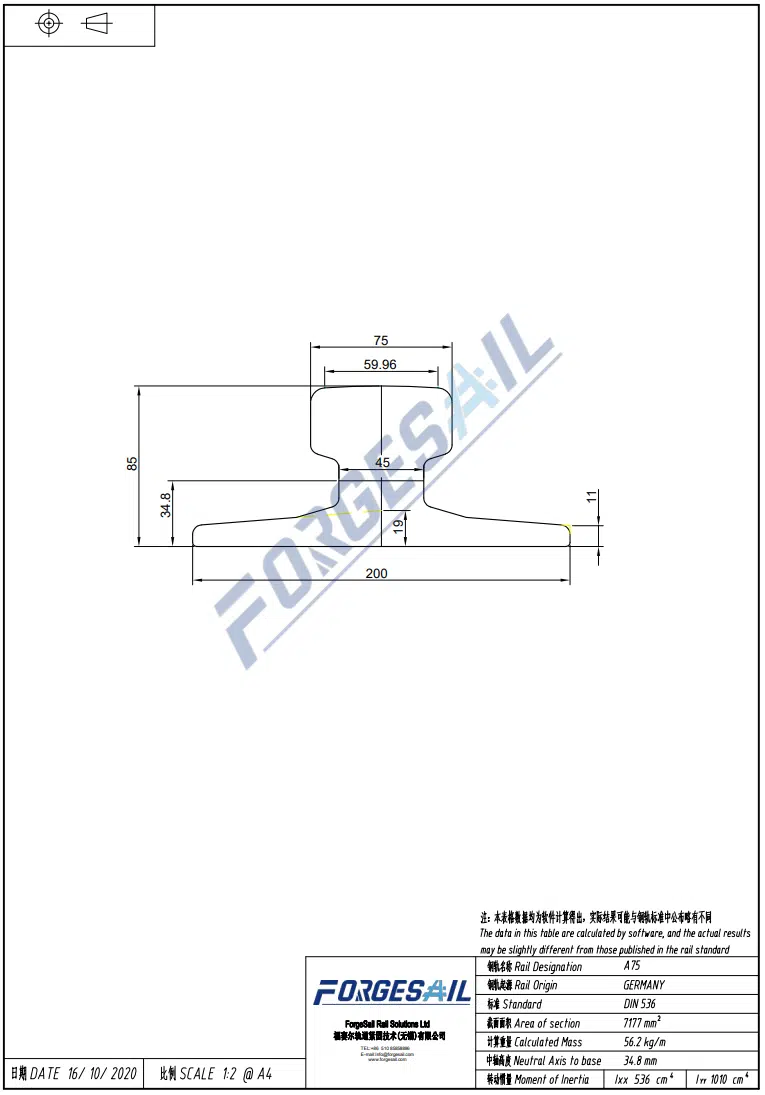
- Rail wear measurement: Using a rail wear gauge or caliper, measure vertical head height loss at identified wear points. Record the measurement in mm and the location. Compare with the manufacturer’s wear limit (typically 10-15% of the original rail head height — for example, 4.5-6.75 mm on an A75 rail (45 mm head)).
- Bolt condition: Inspect a sample of clips for corrosion, deformation, or fatigue cracking. Pay particular attention to clips within 5 m of rail joints and expansion gaps.
For complete rail clip specifications and torque values, see our welded and bolted rail clip product pages.

Quarterly Crane Rail Maintenance Tasks
Quarterly inspections require 3-4 hours and may require a track access permit or lockout/tagout if the inspection is performed on an active runway.
Quarterly tasks include:
- Full track survey: Using optical or laser alignment instruments (total station, laser tracker, or piano wire method), measure rail straightness and alignment. Record deviations in the horizontal and vertical planes. ISO 12488 Class 1 tolerance: ±2 mm over a 2 m base length (overall runway tolerance: ±10 mm).
- Sole plate and grout condition: Inspect sole plates for corrosion, bending, or loss of contact with the grout bed. Tap the sole plate with a hammer — a hollow sound indicates debonding from the grout. Schedule grout repair for any debonded areas.
- Thermal expansion gap audit: Measure all expansion gaps in the rail. Compare with the design specification. Gaps that have closed completely indicate risk of rail buckling in hot weather. Gaps that have opened excessively indicate risk of wheel impact damage.
- Corrosion assessment: Inspect rail clips, bolts, and sole plates for corrosion. Grade each component: Grade 1 (surface rust only), Grade 2 (section loss <10%), Grade 3 (section loss >10% — replace), Grade 4 (structural concern — replace immediately).
Refer to the CMAA Specification #70 or ISO 12488 for complete crane runway tolerance standards.

Annual Overhaul and Rail Replacement Planning
The annual inspection is the most comprehensive maintenance event. It should be scheduled during planned facility downtime and typically requires 1-2 days depending on track length.
Annual tasks include:
- Full rail profile measurement: Measure rail head width, height, and wear at 10 m intervals along the track. Plot wear rate (mm/year) to predict remaining service life. Rail replacement is typically required when vertical head wear exceeds 10-15% of the original head height, or when gauge-corner wear creates a radius less than the wheel fillet radius.
- Ultrasonic testing (if applicable): For heavy-duty tracks (>100,000 tons/year) or rails more than 10 years in service, perform ultrasonic testing to detect internal head cracks or web fractures that are not visible on the surface.
- Bolt replacement: Replace all clip bolts and washers. Nylon-insert lock nuts should be replaced annually as the nylon insert loses locking torque after repeated temperature cycles. For coastal environments, replace bolt assemblies every 5 years minimum.
- Rail clip rotation or replacement: Inspect every clip for fatigue cracking using dye-penetrant testing. Rotate clips between the gauge side and field side to equalize wear if permitted by the clip design. Replace any clip showing visible cracking or deformation.
- Grout assessment and repair: Inspect all sole plate grouting. Chip out and replace any spalled, cracked, or debonded grout sections. Cementitious rail grout can achieve ≥30 MPa in 24 hours, minimizing downtime for repairs.
For grout repair materials, see ForgeSail’s rail grout product information.
Important: A systematic inspection program costs a fraction of a single unscheduled shutdown. Most rail failures are preceded by weeks or months of measurable deterioration that a regular maintenance schedule would detect.
Record Keeping and Trend Analysis
A maintenance program is only as good as its records. Without trend data, a single measurement is nearly useless — it tells you the condition today but not how fast it is changing. For each inspection interval, maintain the following records:
- Daily logs: Operator name, date, pass/fail status for each check item, any issues noted
- Weekly logs: Torque readings from sampled clips, pad condition notes, joint gap measurements
- Monthly logs: Full torque audit data, rail gauge and wear measurements plotted against track position
- Quarterly logs: Alignment survey data, corrosion grade assessment, grout condition photos
- Annual logs: Full profile measurements, ultrasonic test results, clip replacement records
Track wear trends should be plotted graphically — a rail losing head height at 1 mm per year with a 12 mm wear limit has exactly 12 years of remaining life. This data drives capital planning for rail replacement projects.
Contact ForgeSail’s engineering team for custom maintenance program support.
How often should crane rail be inspected?
Daily visual checks by the operator, weekly torque sampling by maintenance, monthly full-torque audits and wear measurements, quarterly alignment surveys, and annual comprehensive overhaul. High-duty tracks (CMAA Class E-F) may require increased frequency.
What is the acceptable wear limit for crane rail?
Typically 10-15% of the original rail head height — for example, 4.5-6.75 mm on an A75 rail (45 mm head). Replace rail before the wear limit is reached; wear accelerates as the rail head flattens, increasing contact stress.
How tight should rail clip bolts be?
M20 bolts (grade 8.8): lubricated condition 400-480 N·m, dry condition 500-550 N·m.
When should rail clips be replaced?
Replace clips when they show visible cracking, permanent deformation, or corrosion section loss exceeding 10%. As a preventive measure, replace all clips after 10 years in moderate service or 5 years in severe/corrosive environments.
What causes uneven rail wear?
Uneven wear is typically caused by crane wheel misalignment, uneven torque on rail clips, soft or deteriorated grout under sole plates, or wheel diameter differences. A laser alignment survey can identify the root cause.
What safety procedures are required before rail maintenance?
Lockout/tagout (LOTO) of the crane power supply per OSHA 1910.147 or local equivalent. Barricade the track area. For elevated tracks, use fall protection. Verify rail isolation from power sources. Only certified personnel should access active crane runways.
What is the recommended crane rail regrinding schedule?
Typically every 3-5 years for moderate-duty tracks, or when surface corrugation exceeds 0.3 mm over a 1 m straight edge. Port and heavy-haul tracks (CMAA Class E-F) may require annual grinding.
How do I identify and repair debonded grout under sole plates?
Tap the sole plate with a hammer — a hollow sound indicates debonding. Drill 12 mm holes at 300 mm spacing, vacuum debris, and inject cementitious grout. Cementitious grout can achieve ≥30 MPa in 24 hours. For gaps exceeding 50 mm depth, gravity-pour from one side.