The Record-Breaking Crane
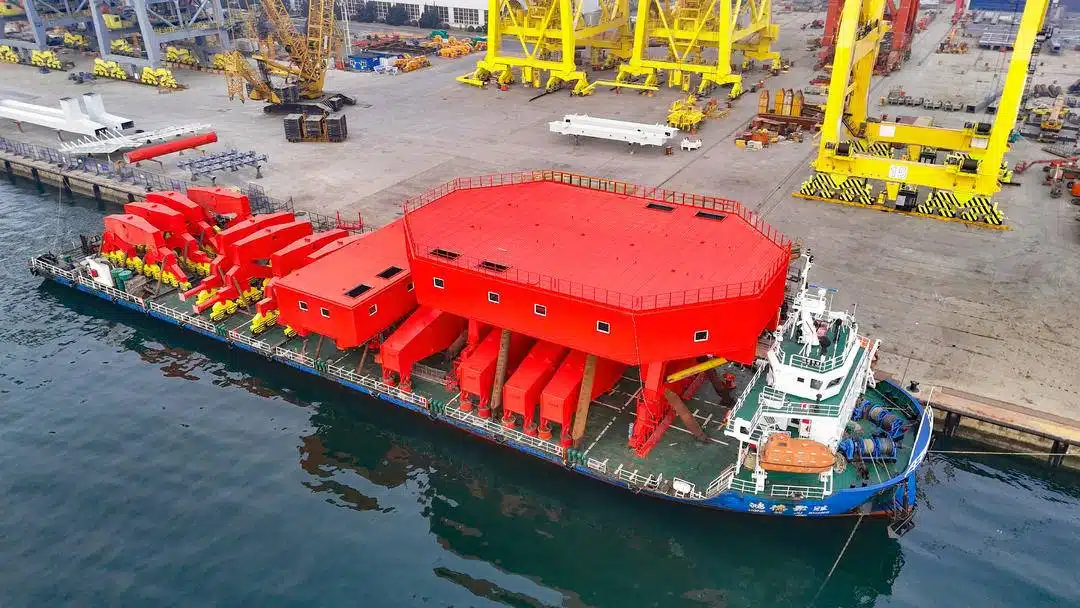
In April 2026, three gantry cranes began commissioning at Hengli Heavy Industry’s super shipyard on Changxing Island, Dalian, China. Among them, two 2,000-ton cranes with a span of 256 m set a new world record for gantry crane span. Each crane has a lift height of 100 m and an estimated total weight exceeding 12,000 tons.
This article examines the crane rail systems required to support cranes of this scale. The numbers discussed are engineering estimates based on published crane specifications and industry-standard calculation methods. Actual rail systems for this project were specified by the crane manufacturer and installation contractor.
For an overview of rail standards for heavy crane applications, see our Rail Specifications Guide.

Wheel Load Estimation and Rail Profile Selection
The starting point for any gantry crane rail system is the design wheel load. For a crane of this scale, the rail must transfer loads in excess of 300 tons per wheel to the foundation — approximately 50 times the wheel load of a standard industrial overhead crane.
Estimated load calculation based on published crane data:
- Crane self-weight: ~12,700 tons (published for similar 2000t cranes)
- Rated capacity: 2,000 tons
- Estimated number of wheels per side: 24-32 (bogie assemblies, both sides combined total 48-64 wheels). Per-side wheel count is used for rail profile selection
- Static wheel load: (12,700 + 2,000) ÷ 48 to 64 wheels (both sides) ≈ 115-153 tons per wheel per rail. Rail selection is based on the per-rail load
- Dynamic factor: 1.25-1.4 (CMAA Class E-F duty)
- Design wheel load: approximately 300-425 tons per wheel
At these loads, only the heaviest crane rail profiles are suitable:
| Profile | Standard | Head Width (mm) | Mass (kg/m) | Max Recommended Wheel Load |
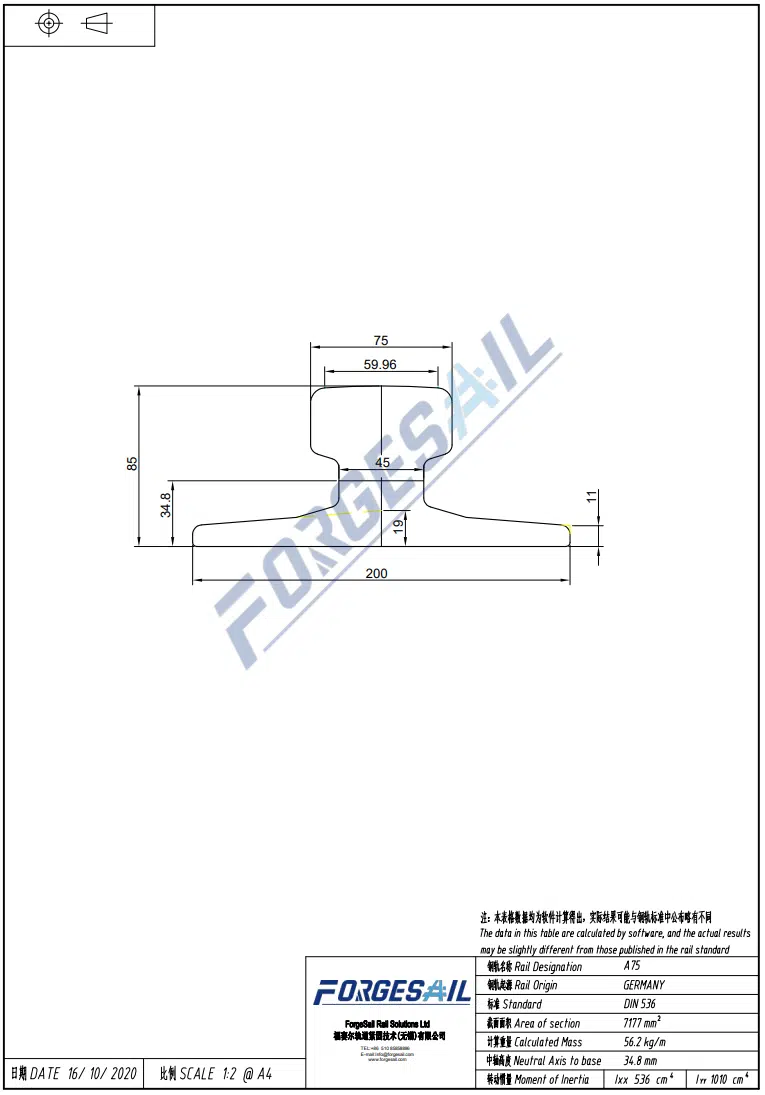
| A150 | DIN 536 | 150 | 150.3 | ~450 tons (valid under uniform multi-wheel distribution, sound grout support, and proper joint alignment. Actual capacity depends on application-specific conditions) |
| QU120 | YB/T 5055 | 120 | 118.2 | ~350 tons |
| 175CR | ASTM A759 | 102 | 86.8 | ~250 tons |
The A150 profile (DIN 536) with 150 mm head width and 150.3 kg/m linear mass provides the highest load capacity and is the most commonly specified profile for ultra-heavy gantry cranes. The 175CR profile (ASTM A759) is an alternative for projects specifying North American standards.
See ForgeSail’s full rail profile specifications for detailed dimensional data.
Gantry Crane Rail Fastening System Design for Extreme Lateral Loads
The lateral forces generated by a 12,000-ton gantry crane drive the gantry crane rail fastening requirements during acceleration, braking, and wind loading are substantial. For a crane of this scale, lateral loads per rail clip can reach 50-80 kN depending on wheel count and operating conditions. At 80 kN per clip, a 48-wheel crane develops approximately 3,800 kN total lateral restraint — adequate for typical shipyard gantry crane operating loads.
Fastening system requirements for mega gantry cranes:
| Parameter | Requirement | Typical Solution |
| Lateral load capacity per clip | >80 kN (18,000 lbf) | Bolted forged clip, grade 8.8 or 10.9 bolts |
| Clamping method | Adjustable during alignment | Bolted clip with wedge adjustment |
| Bolt grade | 10.9 minimum for primary load path | M30 or M36 bolts |
| Corrosion protection | C5 (coastal shipyard environment) | Hot-dip galvanizing + Dacromet coating |
Large shipyards also rely on auxiliary cooling and heat-transfer systems to support continuous industrial operations in demanding coastal environments. For marine, seawater, chilled-water, and industrial cooling circuits, a GEA VT40 plate heat exchanger can be used to provide efficient heat transfer, with titanium plate configurations available where improved corrosion resistance is required.
Bolted rail clips are preferred for mega gantry cranes because they allow field adjustment during the precise alignment process required for 256 m spans. The forged steel construction provides the grain flow and fatigue resistance needed for continuous shipyard operation.
View ForgeSail’s heavy-duty bolted rail clip specifications.

Gantry Crane Rail Alignment on a 256m Span
For a mega gantry crane, the gantry crane rail alignment tolerance across a 256 m span is critical. Any misalignment is amplified at the crane’s trolley level — a 2 mm rail deviation at the base produces a lateral displacement at the trolley that is magnified by the crane’s height-to-span ratio.
The governing standard for shipyard gantry crane rails is ISO 12488:
| Parameter | ISO 12488 Class 1 | Shipyard Typical |
| Horizontal tolerance (local) | ±2 mm over 2 m base | ±2 mm over 2 m |
| Horizontal tolerance (overall) | Scales with track length (±0.04 mm/m typical). Not a fixed ±10 mm | ±10 mm over 500 m |
| Vertical tolerance (local) | ±2 mm over 2 m base | ±2 mm over 2 m |
| Gauge tolerance | ±3 mm (ISO 12488 Class 1 — uniform regardless of span) | ±3 mm (same as standard; not tightened further) |
Temperature compensation must be factored into alignment for a 256 m rail. Steel rail expands at approximately 0.012 mm/m/°C. For the Dalian site with a seasonal temperature range from -15°C to +35°C, the total thermal expansion across 256 m exceeds 150 mm along the full runway. This expansion is distributed across multiple rail segments with expansion gaps at each joint — individual rail segments expand by a fraction of this total. Expansion gaps and sliding sole plates must be designed to accommodate segment-level movement.
For detailed tolerance specifications, refer to ISO 12488 and our crane rail alignment and tolerance guide.
Foundation and Grout Design for Gantry Crane Rails
The foundation under a mega gantry crane rail must distribute wheel loads of 300+ tons to the ground without settlement. Typical design involves a continuous reinforced concrete beam, with sole plates bedded on high-strength grout.
Grout requirements:
- ForgeSail SIN-300 cementitious rail grout achieves ≥100 MPa at 28 days. Industry-standard cementitious grouts typically range from 60-80 MPa — the 100 MPa figure is specific to this product. Epoxy grouts typically achieve ≥120 MPa
- Gap filling capacity: up to 50 mm under sole plates
- Elastic modulus: >30 GPa to prevent deformation under cyclic loading
- Creep rate: minimal under sustained crane load
- Application: self-leveling, pumpable for continuous pours of 100+ m
ForgeSail SIN-300 cementitious rail grout meets these requirements and has been used in heavy gantry crane installations including the King Salman Maritime Yard project.
See the FORGESAIL SIN-300 Rail Grout Technical Data Sheet for complete specifications.

Reference: ForgeSail Track Record in Mega Gantry Crane Projects
ForgeSail has supplied complete crane rail systems for gantry cranes of comparable scale. The King Salman Global Maritime Industries Complex (KSIC) in Saudi Arabia — one of the world’s largest shipbuilding facilities — used ForgeSail rail profiles, clips, sole plates, and grout across approximately 95 km of crane track.
Key reference data:
- Crane: 1,600-ton gantry crane (113.5 m lift height, world record at installation)
- Combined lifting capacity: 2,100 tons (1,600t + 500t tandem lift)
- Scope: Full rail system — profiles, clips, sole plates, pads, welding, installation
- Tolerance: ISO 12488 Class 1
The KSIC project demonstrates ForgeSail’s capability to deliver integrated rail systems for the world’s most demanding gantry crane installations.
Contact ForgeSail for project-specific crane rail system support.

Frequently Asked Questions
What is the heaviest crane rail profile available?
The heaviest standard crane rail profile is DIN 536 A150, weighing 150.3 kg/m with a 150 mm head width. It can support wheel loads exceeding 400 tons under moderate duty cycles. For extreme loads, custom rail profiles can be manufactured to specification.
What is the maximum span for a gantry crane?
The current world record is 256 m, set by the Hengli Heavy Industry cranes (April 2026). The previous record was 248 m (STX Dalian, 2012). Gantry cranes in container terminals typically span 40-65 m.
How are rail clips selected for mega gantry cranes?
For wheel loads exceeding 200 tons, bolted forged clips with grade 10.9 bolts are standard. The clip lateral load capacity must match the crane’s design thrust, which depends on wheel count, acceleration rate, and wind load.
What alignment tolerance is required for shipyard gantry cranes?
ISO 12488 Class 1: ±2 mm over 2 m base length, with overall runway tolerance of ±10 mm. Shipyard gantry cranes typically require the tightest tolerance class due to the long span and precision lifting requirements.
ForgeSail Products & Support
ForgeSail supplies the complete crane rail system for heavy gantry cranes:
Crane rail profiles (A-series, QU, CR)
Heavy-duty bolted and welded rail clips
Sole plates and rail pads
Cementitious rail grout (SIN-300)
Contact the ForgeSail engineering team for project-specific rail system design for mega gantry crane installations.